
Latest news
- Walk for Daniel Day – NMPCC helping to celebrate the 20th anniversary of the Daniel Morcombe Foundation
 Walk for Daniel Day – NMPCC helping to celebrate the 20th anniversary of the Daniel Morcombe FoundationOn 25th October 2024, National Missing Persons Coordination Centre (NMPCC) members attended the Daniel Morcombe Foundation’s (DMF) annual Walk for Daniel.Deputy Commissioner Lesa Gale, Commander Joanne Cameron and AFP members joined over 2000 community members, school children, emergency services and government officials on the 4km walk. The route through Woombye from the Suncoast Christian College to Briggs Park in Palmwoods, represents the journey home Daniel was unable to complete. The annual event inspires members of the community to walk together to raise awareness of child safety, fundraise and to walk Daniel home. This year’s walk was held on the DMF annual Day for Daniel to commemorate the 20th anniversary of the DMF and launch the foundation’s latest initiative, a free digital children’s book, Wobbly Jelly. The book is designed to prevent abuse and promote lifelong health and wellbeing by encouraging important conversations about child safety and educate children about body clues and how to Recognise, React, and Report unsafe situations.Through collaborative initiatives between the AFP, DMF and other not for profit organisations and community groups, together we are continuing to shine a light on the importance of child safety and supporting families affected by missing children.25Oct 2024
 - National Missing Persons Coordination Centre Stakeholder Forum
 National Missing Persons Coordination Centre Stakeholder ForumThe National Missing Persons Coordination Centre (NMPCC) hosted its first stakeholder engagement forum in recent years which provided non-government organisations (NGOs) and families of missing persons the opportunity to share their views and perspectives on improving our collective efforts to respond to missing persons. The event, held on 20 September 2024, was attended both in person in Canberra and virtually by interested parties from around the country. ‘Engaging with stakeholders provides us with the victim survivor voice which is critically important to ensure we're building something relevant to the community,’ said Commander Joanne Cameron, who chaired the event. Powerful and emotive roundtable discussions highlighted the importance of the continued communication between law enforcement and the families of the long-term missing, through periodic updates and social media.Stakeholders provided valuable insights and suggestions to improve the language and cultural awareness in educational campaigns and tools which support families navigating the process of reporting a loved one missing.The program commenced with a presentation by Commander Helen Schneider from the Australian Centre to Counter Child Exploitation on their successful strategies to achieve greater community outcomes through partnerships with stakeholders and NGOs.Commander Cameron concluded the event with an update on Project Restore, a Forensics Command initiated project to continue to provide specialist forensic capabilities to support policing partners in missing persons and unidentified remains, and related complex criminal investigations. This project will combine the specialist capabilities and consolidate them alongside NMPCC and Disaster Victim Identification to continue to generate investigative leads and resolve enduring long term missing persons cases.This forum, which will be the first in a series conducted as part of the consultation phase of Project Restore, was a powerful step in supporting those most affected by someone missing. This embeds the NMPCC mission to continue to reduce the incidence and impact of missing persons in Australia.20Sep 2024
 - Ethical hackers unite to find missing persons
 Ethical hackers unite to find missing personsOn Friday 13 September, 646 participants across Australia and online, took part in the 2024 National Missing Persons Hackathon (the hackathon). The event was hosted in each capital city, with the main event held at Tech Central Scaleup Hub in Sydney.The hackathon was first delivered in 2019 in partnership with the AFP’s National Missing Persons Coordination Centre (NMPCC). It was the world’s first large-scale, crowdsourced open-source intelligence (OSINT) gathering of its kind in Australia for missing persons.This year NMPCC supported the event by working with state and territory police to identify suitable missing persons cases to be featured in the ‘capture the flag’ competition. Five missing persons cases were presented to participants to begin sourcing intelligence and potential leads during the 6-hour event.A total of 500 reports with new leads were submitted by participants to a panel of judges who verified the information and allocated points. Winners of the hackathon were announced on Monday 23 September with first place going to Phish & Chips who attended virtually, second place went to Tasmanian team Thick Thighs Saving Lives, third place went to Victorian team to Gridware and fourth place to South Australian team 5. Prizes included challenge coins and OSINT training. All leads are being collated by Hackathon case managers and NMPCC. Information will be shared with relevant jurisdictions to assist with each missing person’s case.13Sep 2024
 - National Missing Persons Week 2024: Always Searching
 National Missing Persons Week 2024: Always SearchingThis year’s National Missing Persons Week campaign will focus on 8 missing Australian women.The AFP is shining the light on long-term missing women this National Missing Persons Week (NMPW), calling on the Australian public to come forward with new information that could help bring them home. This year from 28 July – 3 August, the campaign Always Searching will focus on the continuing efforts of police to solve missing persons investigations.Throughout the week, 8 missing women will be featured, providing an opportunity to raise awareness and encourage the community to come forward with any information they may have. Each case will highlight a different long-term missing person who has been selected in consultation with state and territory police.The recurring message of this year’s campaign is that no matter how tiny the detail, police are committed to following leads and information to help find families’ loved ones.For further information, please click here25Jul 2024
 - NMPCC X ACT Dog Team
 NMPCC X ACT Dog TeamThe National Missing Persons Coordination Centre (NMPCC) interviewed Canine Handler, Leading Senior Constable Peter Hockings and his canine Rogue, to learn about how the ACT Dog Team/AFP General Purpose Team assists in the search and rescue of missing persons.When a member of the public is reported as missing, members from the AFP General Purpose Team will respond. “In the event that we're required to use a dog to locate and track a person who is missing, we are one of the first teams to respond to such an event, especially if it's a young child or an older elderly member of the community”. The AFP General Purpose Team currently has 5 General Purpose Dogs that are deployed in the ACT region as well as nationally and internationally to help bring loved ones home.Leading Senior Constable Hockings explained how their canine partners assist in search and rescue missions and how environmental factors, such as high winds, can influence a canine's ability to track scents. Wind can disperse odours, making it more challenging for dogs to follow a direct trail. “Our dogs may not necessarily track and locate odour where the person walked, but the wind may have pushed the odour off to one side. So that's where the dog will be working when the odour pool is the strongest”.The NMPCC and the AFP General Purpose Team are dedicated to continuing to assist in the search and location efforts for those who are missing.Please see the full interview below:9Jul 2024
 - International Missing Children's Day 2024 - Commemorate, Remember and Continue
 International Missing Children's Day 2024 - Commemorate, Remember and ContinueEvery year on the 25th May, the Global Missing Children’s Network (GMCN) commemorates International Missing Children's Day (IMCD) by honouring missing and abducted children, and celebrating those who have been recovered.This year the National Missing Persons Coordination Centre (NMPCC) marked IMCD by highlighting the core objectives of IMCD: to commemorate missing children who have found their way home, remember those who have been the victims of crime and continue efforts to find those who are still missing.The NMPCC featured missing children’s profiles during the week leading up to IMCD across their social media platforms. The missing children’s profiles were nominated by state and territory policing partners. A selection of profiles were accompanied by a quote provided by either the family of the missing person or the case officer working on the case. These quotes highlighted case officers’ continuing efforts to locate missing children and special memories shared by family members.Mother of missing child Megan Mulquiney shared: “Megan was gentle, warm and loving and a little bit shy. She was a beautiful girl. I never stop hoping I will have answers about Megan’s whereabouts. It’s been nearly 40 years and it never goes away”.Commander Forensics Joanne Cameron filmed a captivating video to remind members of the public the true meaning behind IMCD. Additionally, this video encouraged the audience to view the missing children featured in this year's IMCD campaign and share any information which may assist in locating these missing children to Crime Stoppers via 1800 333 000.To mark IMCD the NMPCC shared a children focused missing persons poster. Featuring 8 profiles of missing children from around Australia, the poster was created in the hope of generating public awareness for their cases. The IMCD missing children poster and all other missing person posters can be viewed on our website.To view the IMCD commemoration video and to learn more about the 2024 campaign, please visit the NMPCC Facebook, Instagram and (X) pages.Missing Persons Profiles can be viewed on the Public Register.23May 2024
 - Age Progression - Lorrin Whitehead
 Age Progression - Lorrin WhiteheadFebruary 8, 2024 marked the 11th anniversary since Lorrin Whitehead went missing. Lorrin was last seen at 4:55pm on 8 February 2013. She would now be 53 years old.By utilising family photos, as well as knowledge of the effects of ageing, Forensic Artists at the Australian Federal Police have created an artist’s impression of what Lorrin might look like today. The above image shows a comparison of Lorrin in 2013 to today.The image created is an approximation of what Lorrin would look like today. This insight not only provides the family and police vital information, it also provides a new tool to share with the public, who may be able to assist in solving Lorrin’s case.There still are grave concerns for Lorrin’s welfare as she is a Type 1 Insulin Dependent Diabetic. If you have information that may assist police in locating Lorrin, please call Crime Stoppers on 1800 333 000 or visit www.crimestoppers.com.auFor more information on the age progression process, you can visit –www.missingpersons.gov.au/age-progressionFor more information on Lorrin’s disappearance, please visit –www.missingpersons.gov.au/search/vic/lorrin-whitehead21Mar 2024
 - Why do people go missing?
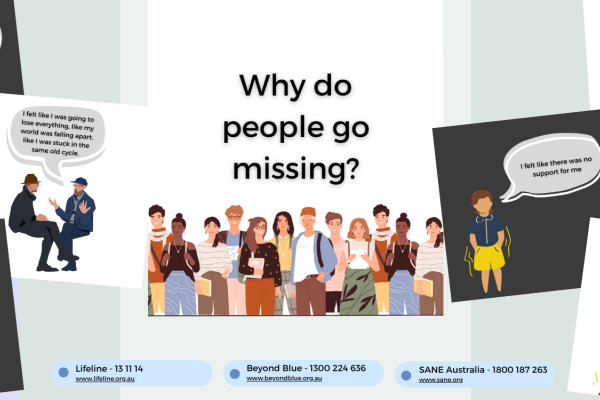 Why do people go missing?Recently we ran a social media series exploring the reasons people went missing and what they were feeling and experiencing at the time. Anyone, regardless of gender, age, ethnicity or educational background may become a missing person. The reasons for going missing are many and varied and can include mental illness, miscommunication, misadventure, domestic violence, and being a victim of crime. The unique reasons featured in the series offer some perspective into the different reasons people go missing, but also serve as a reminder that we never know what someone is going through and to consider how we could support someone at risk of going missing. If you know someone who is struggling or at risk of going missing, find information about how you can support them here: www.missingpersons.gov.au Search @AFPNMPCC on Facebook, Instagram and X (Twitter) to see the full series.31Jan 2024
 - National Missing Persons Week 2023: Can you solve the case?
 National Missing Persons Week 2023: Can you solve the case?The AFP is calling for Australians to put on their detective hats and assist forensic investigators unpick clues that could help crack some of the nation’s longest unsolved missing persons cases.Launched today for National Missing Persons Week, which runs through 5 August, the Can you solve this case? campaign is focused on eight cases involving unidentified human remains.While forensic experts continue to examine the remains, police hope the public can piece together other clues that could help match them with one of the more than 2500 long-term missing persons cases on file in Australia.The AFP’s National Missing Persons Coordination Centre, working with state and territory law enforcement agencies, has created an online “investigative board” to provide amateur sleuths with a detailed detective’s overview of the cases.Vital clues such as clothing and objects found at the scene of the human remains and craniofacial reconstructions can be viewed in 3D animation.The craniofacial reconstruction highlights how the AFP uses cutting-edge technology to continue investigating old cases.As part of its National DNA Program for Unidentified and Missing Persons (Program) capabilities, AFP forensic specialists are able to use new tools to estimate an unidentified individual’s year of birth and death, ancestral origin, hair and eye colour, facial appearance and genetic relatives.The reconstruction used this year is from remains found in the Northern Territory with forensic testing conducted by the Program determining the remains belonged to an Aboriginal female who was older than 18, however, DNA testing has revealed no database links to relatives.AFP Assistant Commissioner Hans Koenderink said community members were law enforcement’s most important partners and this campaign provided them an insider’s view of the AFP’s work and forensic capabilities.“This campaign capitalises on the increasing popularity of the “true crime” genre and, challenges the community to delve into the case files just like our AFP forensic officers do everyday,” he said.“The AFP and state and territory police forces are this year focusing on unidentified human remains cases – as they are not just case numbers but are unknown individuals who have names, families and stories that deserve to be told.“For these loved ones, living with the uncertainty about the whereabouts and safety of a loved one can be a traumatic experience that can last for weeks, months or, sadly, years.“In Australia, there are 750 unidentified human remains and 2500 long-term missing persons cases.“The community plays a critical role in helping police with information that can help to solve a missing persons case.The eight unidentified persons nominated by the AFP’s state and territory counterparts to be featured in this year’s campaign are located at Pyrmont (NSW), Leanyer (NT), the Stretton Wetlands (QLD), King’s Beach (SA), Mt Osmond (SA), Pardoe Beach (TAS), the Dandenong Ranges (VIC) and , Chidlow (WA).In Australia, a missing person is defined as anyone who is reported missing to police, whose whereabouts are unknown, and where there are fears for the safety or concern for the welfare of that person. A long-term missing person is someone who has been missing for more than three months.In 2022, there were over 55,000 missing persons reports made to police in Australia. This is nearly 150 missing reports per day.LINK TO ALL CASEShttps://www.missingpersons.gov.au/national-missing-persons-week-2023National Missing Persons WeekMembers of the community sharing their stories and support throughout NMPW 2023 are encouraged to use the hashtag #NMPW2023.Media is encouraged to read the Counselling Framework for guidance when working with families of missing people.Anyone with information relating to a missing person should contact Crime Stoppers on 1800 333 000.About the NMPCCThe AFP’s National Missing Persons Coordination Centre plays an active role in coordinating national police efforts, and educating the Australian community to prevent the incidence and impact of missing persons in Australia.The National Missing Persons Coordination Centre is a non-operational arm of the AFP, which put simply means the team is not involved in the investigations of missing persons. All investigations are undertaken by the relevant State and Territory police.In support of NMPW, the AFP NMPCC coordinates an annual police campaign with State and Territory police, highlighting a different theme each year to raise awareness of the significant issues associated with missing persons and profile long-term missing persons to reduce the incidence and impact of missing persons in Australia.The annual police campaign compliments other campaigns, events, initiatives and memorial services run by families with a missing loved one, advocacy networks, government and non-government organisations, and members of the public.About the National DNA ProgramIn July 2020, the AFP National Missing Persons Coordination Centre was granted $3.594 million under the Proceeds of Crime Act 2002 to launch the AFP National DNA Program for Unidentified and Missing Persons under the leadership of Associate Professor Jodie Ward.The aim of this multifaceted, multidisciplinary and multiagency Program is to apply a suite of advanced forensic science techniques to unidentified human remains to assist Australian law enforcement restore their identity and reunite them with the families that have missed them for years.So far, the National DNA Program for Unidentified and Missing Persons has assisted to resolve the identity of more than 10 unidentified human remains and link them to long-term missing persons.The success of this nationally-coordinated Program has centred on working collaboratively with police, coronial and forensic agencies across Australia to resolve these cold cases, and importantly, families of missing loved ones who are integral to this DNA-led identification effort.Media enquiries:AFP Media: (02) 5126 9297Connect with us:Follow our Facebook, Instagram and Twitter pages to learn more about what the National Missing Persons Coordination Centre does and to follow the campaign.29Jul 2023
 - International Missing Children’s Day 2023: The important conversation between parents and children about safe behaviour
 International Missing Children’s Day 2023: The important conversation between parents and children about safe behaviourThe AFP’s National Missing Persons Coordination Centre (NMPCC), in partnership with The Daniel Morcombe Foundation, have today on International Missing Children’s Day 2023 (IMCD) released online resources to encourage parents to talk to their children about safe behaviour.IMCD is an internationally recognised day to commemorate the missing children who have found their way home, remember those who have been victims of crime and continue efforts to find those still missing.Assistant Commissioner Justine Gough said this year’s IMCD presents a valuable opportunity for parents and guardians to have important conversations with their children about online and offline safety.“The AFP and NMPCC, in partnership of the Daniel Morcombe Foundation, have released a suite of tools and resources to support parents and guardians talking to their children about safe behaviour,” Assistant Commissioner Gough said.“It may be a tough conversation for parents and guardians to have, but it can help keep children safe and protected.”Assistant Commissioner Justine Gough said the resources provide safety tips for both parents and children to familiarise themselves with. “Being safe on social media is as equally important for children as for parents. Remember to remove friends or followers you don’t know, set your child’s and your own accounts to private, and only share photos with people you know and trust,” said Assistant Commissioner Gough.“Ensure your child knows their full name, home address and parents’ phone numbers and keep a copy of this information in their backpack.”“Before visiting crowded places or events, dress your child in bright clothing and agree on a meeting spot in case they get lost.”Bruce Morcombe and Denise Morcombe said when a child goes missing the impact on family and friends is huge.“We need to be better at supporting those left behind who are dealing with unresolved loss,” Bruce Morcombe said.“IMCD provides a valuable opportunity to educate our young people on ways to stay safe. We recommend that it starts with the creation of a “Family Password.“Teach your children that no matter what is offered or story told, they cannot get into a car or secretly meet anyone that does not know your family’s special word.”“Parents need to have updated photos and medical records of their children and know what their children are wearing in case they go missing,” Denise Morcombe said.The suite of downloadable IMCD digital resources is available below.Media enquiries:AFP Media: (02) 5126 9297Click the icons below to download the resources and start a conversation today!24May 2023
 - National DNA Program partners with Othram to use forensic genetic genealogy for unsolved Australian cases
 National DNA Program partners with Othram to use forensic genetic genealogy for unsolved Australian casesThe AFP will have access to specialised forensic DNA testing, not currently available in Australia, to identify human remains and develop new leads for unsolved crimes, by partnering with a world-leading forensic genomics laboratory.Under the agreement, the AFP’s National DNA Program for Unidentified and Missing Persons will provide forensic evidence from some of Australia’s most challenging unidentified and missing persons cases to the United States-based forensic genomics laboratory Othram to be examined using advanced forensic DNA tools, including Forensic Genetic Genealogy (FGG).Othram is the world’s first purpose-built FGG laboratory for human identification applications. Over the last three years, Othram’s technology has helped law enforcement agencies in the United States and Canada solve many decades-old cases.FGG combines cutting-edge DNA testing methods, public DNA databases and traditional genealogy research to provide investigative leads that can help identify unknown individuals. The process leverages DNA comparisons with distant genetic relatives to reconstruct family trees and narrow down the search to a region, a family or an individual.FGG testing is now underway at Othram for several Program cases not solvable using standard forensic techniques and searches of national law enforcement databases. The longer-term benefits of this partnership will include technology and knowledge transfer, joint research projects and establishment of best practices for using FGG for human remains identification.The National DNA Program, which commenced in July 2020 and is funded until December 2023, is dedicated to identifying human remains found across Australia and resolving missing persons investigations. The Program is funded from the Commonwealth’s Confiscated Assets Account, which enables the Commonwealth to redirect criminal assets back into the community.National DNA Program Lead, Associate Professor Jodie Ward, said the new partnership demonstrated the ongoing commitment of the AFP to apply the latest forensic technologies to identify deceased individuals, locate missing persons and provide families with the answers they deserve.“For many of these cases, FGG technology will be our last resort to reunite the remains of unknown Australians with the families missing them”, Associate Professor Ward said.The Australian public can assist the Program’s goal to identify up to 750 unidentified human remains by voluntarily submitting their DNA profile to genealogy databases that law enforcement can search. The Program can then compare DNA profiles recovered from the remains against DNA profiles from the public, in the hope of matching them to genetic relatives.Associate Professor Ward said, “The Program’s success using FGG will grow as more Australians choose to get involved and join these database expansion efforts, especially for our long-term missing persons cases where there are no close relatives available to provide a familial DNA sample”.The National DNA Program and law enforcement agencies worldwide can currently search three genealogy databases for defined investigative purposes – they are Othram’s private database ‘DNASolves’, and two public databases ‘FamilyTreeDNA’ and ‘GEDmatch’.More information on how a member of the public can submit their DNA profile to a genealogy database for law enforcement searching, and how the Program uses FGG to assist them resolve unidentified and missing persons cases, can be found on the National DNA Program website.More information on the AFP National Missing Persons Coordination Centre can be found on the Centre’s website or by contacting the Centre via email: missing@afp.gov.au or phone: 1800 000 634.More information on Othram’s technology, genealogy database and recently solved cold cases can be found on the Othram website.Connect with the AFP: Follow our Facebook, Twitter, LinkedIn, Instagram and YouTube pages to learn more about what the AFP does to keep Australia safe.26Oct 2022
 - National program using DNA to identify missing persons extended until end of 2023
 National program using DNA to identify missing persons extended until end of 2023National Missing Persons Week 2022 reminds us of the many thousands of Australians left wondering, asking, searching and holding onto hope for their missing loved one.A unique national program has been extended for a further 12 months to provide more opportunities for the AFP National Missing Persons Coordination Centre to use the latest forensic techniques and databases to help Australian law enforcement agencies identify human remains and help families of long-term missing persons in their quest for answers.The National DNA Program for Unidentified and Missing Persons launched in July 2020 using Confiscated Assets Account funding, which allows the Commonwealth to redirect ill-gotten gains back to the community. The extension will allow the Program’s specialists to test a larger number of unidentified human remains in pursuit of restoring their names and faces.The most recent national case audit has reported 750 sets of human remains, with the Program so far assisting with 55 cases received from State and Territory police agencies across Australia. Of these, 36 samples have been submitted for specialist DNA testing in the Program’s DNA laboratory that launched at the AFP Forensics Facility in December 2021.DNA profiles recovered from the remains have resulted in five matches to long-term missing persons to date, contributing important evidence for coronial investigations. One of these is Mario Della Torre, missing since 1976, whose identity was confirmed by the South Australian Coroner in February 2022 following testing of bones found at False Bay in 1977. The Program also provided the Royal Australian Navy with DNA evidence to support the identification of the “Unknown Sailor” as Able Seaman Thomas Welsby Clark last year.Associate Professor Jodie Ward said these results are an example of how advancements in forensic science can provide fresh hope for previously unsolved cases and resolution for families with loved ones still missing.“Just being able to identify one person, to be able to give answers to one family, would make this all worth it – but we have now surpassed that goal,’’ Associate Professor Ward said.“However, there’s more work to be done. The extension will allow the Program team to generate investigative leads for many more cases in order to discover who these unknown Australians are and reunite them with families missing them.”The Program’s success relies on families of every long-term missing person providing police and forensic investigators with vital information, records and samples for comparison. Relatives are encouraged to participate in the Program by completing the online Missing Person Details Form and providing a familial DNA sample along with any personal effects, medical and dental records, and photographs of their missing loved one.Associate Professor Ward says, “As well as searching dental records and DNA profiles looking for matches, our forensic specialists can use new tools to estimate an unidentified individual’s year of birth and death, predict ancestral origin, hair and eye colour and facial appearance, and find genetic relatives.”For more information on the National DNA Program for Unidentified and Missing Persons visit the Program Website or contact the National Missing Persons Coordination Centre via email: missing@afp.gov.au or phone: 1800 000 634.Connect with the AFP: Follow our Facebook, Twitter, LinkedIn, Instagram and YouTube pages to learn more about what the AFP does to keep Australia safe.8Aug 2022
Do you have any information relating to a missing person?
Report to Crime Stoppers on
or
Report information via their website
Do you need an interpreter?
If you require assistance in contacting the NMPCC, we are a client of the national Translating and Interpreting Service (TIS National).
Call TIS National on
Call 24 hours, seven days a week.
This service is available to anyone in need of an interpreter. Information translated by TIS National Service is kept strictly confidential.
Do you want to report someone missing?
Call Police Assistance on
Or visit your local police station
Media and partnership enquiries
For all media enquiries please contact AFP Media
Call AFP Media on
or
Email AFP Media at