
Latest news
- A man without a name
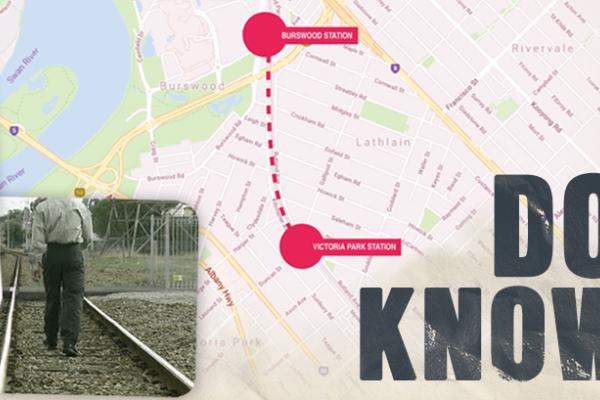 A man without a nameA body was found by WA Police after being struck by a train on 7 March 1998, but unfortunately his identity still remains a mystery to this day.WA Police Senior Constable Jen Robinson led the search for a family member, a friend – anyone who might have known the man but found no one.Although ‘John Doe’ has been missing since 1998, we do not know if he is missed.In an attempt to discover the identity of this man, DNA and fingerprinting testing was undertaken and ran both domestically and internationally. He was even profiled on national crime show ‘Australia Most Wanted’ in hope that someone would recognise his description and the circumstances surrounding his death – this was not the case.What we do know is that he was between 20-40 years old and 170-175cm tall.He had hazel eyes and thinning ginger-brown hair.At the time he was wearing a green-blue business shirt, green trousers, a brown belt and black Rivers-branded shoes.Beyond this, we can only speculate about this man and his life; Did he have debts? Was he a visiting sailor or perhaps a local whose family relationships had broken down?Was he a brother?Was he a father?Is there someone out there that thinks of him every morning and night, wondering where he has gone?These are questions we sadly can’t answer.Senior Constable Jen Robinson, who organised a funeral for the unknown man in 1999, wants answers as much as anyone. “We just wanted to be able to say to his family ‘we did give your son a farewell.’” Jen continues “The seventh of March doesn’t go by without me thinking of him - it’s like Remembrance Day for me.”It shows that missing persons – even those police cannot identify – are never completely forgotten.Cast your memory back, were you near Burswood or Victoria Park Train Stations in Perth on 7 March 1998? Did you know someone who went missing around that time? You may have a small piece of the larger picture.Report any information through to Crime Stoppers on 1800 333 000.7Aug 2018
 - Missing persons and dementia
 Missing persons and dementiaOn the 15 September 2017, Youliang Lin took himself for a walk. A seemingly normal activity for most people however, Youliang suffered from dementia and thus required ongoing support from his family to ensure his safety when he had ongoing bouts of memory loss. Unfortunately it was on this day that Youliang did not return home and sadly has not been seen since.Youliang’s granddaughter Helen and his daughter Dan spent some time reflecting about their loved “patriarchs” life;“He was a kind, sweet, quiet and peaceful man. Always putting people before himself,” Helen says.With a large family of 7 grandchildren and 3 children, Youliang enjoyed cooking meals that they could all enjoy together whether it be in their small apartment back in China or in their residence in Castle Hill, Sydney; no space was too small for the Lin family and Youliang was always taking in “stragglers” who he felt could enjoy his cooking and company also. This is a perfect reflection of the warm hearted and caring person described by Dan and Helen.Youliang, along with over 425,000 other Australians suffer from dementia. Demential is a term used to describe the symptoms of a large group of illnesses which cause a progressive decline in a person's mental functioning.Prior to Youliang’s disappearance, he had gone wandering before. Helen recalls that her grandad would often enjoy a daily walk and would frequently walk to the shops. It was on some of these occasions that Youliang would become confused and unsure of his surroundings.It was these instances that sparked a family decision to no longer allow Youliang to leave the house on his own, for his own safety.While discussing the immediate aftermath of her grandfather’s disappearance, Helen reflects on the overwhelming public support and astonishing efforts from the Australian/Chinese community in particular. With over 200 volunteers searching the suburbs, nearby bushland and national parks, as well as the systematic approach to the search by relative strangers, the Lin family describe their response as being “really, touched, surprised and heartened”.There was an individual standout by a community member who spent her days combing Sydney suburbs in search of Youliang. This person was not known to the Lin family prior to Youliang’s disappearance however, she would spend her days combing the streets for answers. It is kind hearted people like this who demonstrate how widely affected and responsive a community can be in instances of a person going missing.When asked what advice they would like to provide to other families who may be supporting a loved one who suffers from dementia, Helen replies;“In our situation the family were aware of what was happening with my grandfather’s situation but we weren’t really open about it with his friends and their social group, and so my Mum wonders whether if we had worked more in building that support network with their friends that maybe it would have been easier, just to have more people able to understand what was going on and be supportive, so you’re not so alone.The day he went missing he actually did run into some of his friends while he was walking and they didn’t realise what the situation was, so they didn’t see anything that was wrong. They had just chatted a bit and he kept on going.” Further advice from the Lin family is to “Take each day as it comes and take every happy day as a win and give yourself some validation. You are not alone and there are others in a similar situation.” For further information on dementia, please visit the Dementia Australia website here.Youliang left his home on Cooper Court, Castle Hill about 8am on Friday 15 September 2017 and sadly he has not been seen since. He was 84 years old at the time of his disappearance.6Aug 2018
 - The unexpected burden of a missing loved one
 The unexpected burden of a missing loved oneWhen Christine Forster’s husband and life partner of 24 years went missing in October 2017, she never imagined the emotional rollercoaster she would have to go on to regain control over her family’s financial future; from her sons’ looming school fees and the replacement of the family car, to disputes over her husband’s work entitlements and superannuation.Following a loved one’s disappearance, for some families the financial impact can be just as devastating as the emotional impact. Not only is their loved one missing but they also have to deal with the predicament of not being able to stop phone bills, cancel memberships, close accounts, or maintain mortgage payments.In many cases, police will have reasonable grounds to suspect the missing person is deceased, only to take a number of years before a Coroner finds the person deceased, allowing a death certificate to be produced. Only then can a family administer the estate of a missing person.Christine spoke during the lead-up to National Missing Persons Week 2018 about the financial pressures that have now been placed on her family since the disappearance of her husband.“When John went missing, our family lost approximately 75 per cent of our income,” Christine said.“It is hard enough having to deal with not knowing what has happened to John and how to manage our lives without any closure, but it is made so much harder when we have to cope with the burden of potential financial hardship.” Christine said the experience has brought out the best and worst of people and institutions, highlighting the challenges that many families of missing persons go through.“We have had to deal with banks, employers and other institutions that do not recognise or understand the ordeals endured by families of missing people. This has included having to provide definitions of the word ‘missing’, overcome privacy concerns and fight to ensure we receive John’s entitlements.“I have also found our dealings with these institutions to be shockingly insensitive at times. For instance, I was hurt in the manner that I was told that they could terminate John’s employment after 20 work days after he went missing. For someone who hadn’t missed a work deadline in 20 years, his termination due to ‘abandonment of duties’ just didn’t seem right.“However, while this has been an incredibly upsetting time for my family, there have been some wonderfully supportive people. I’ve received kind-hearted and practical help from my son’s school whose principal has gone above and beyond. “He attended a meeting with me at my husband’s employer to outline our family situation and determine what their HR actions may be – without him I wouldn’t have been able to speak. Further, knowing the stress I was under, he offered to defer all school fees for my two sons until our financial disputes are resolved. We have been in survival mode over the past year and without the school’s support I couldn’t have coped. We are still waiting.”In recounting the day John went missing, Christine says she went from kissing him goodbye on a Saturday morning to, later that night, listening to search helicopters passing overhead to scan Sugarloaf Reservoir, where police found his car.“By this stage I was frantic with worry as I struggled to comprehend what was happening and scared that John was lost out there in the dark and in the bush,” Christine said.“John didn’t have a great sense of direction and he is risk adverse so I kept hopeful that he would navigate by the stars or stay put and wait for rescuers if he was injured. It was the beginning of a nightmare and, now, I’m moving in an unknown direction and desperately trying to regain some control. This is not how John and I saw our lives turning out – these were not the plans and dreams we set together.” Told by Christine Forster, 2018Christine’s husband John Forster was last seen on 7 October 2017 at their family home in Diamond Creek, Victoria. That night, John’s car was located at Sugarloaf Reservoir in Christmas Hills. He was 59-years-old at the time.6Aug 2018
 - A family's legacy
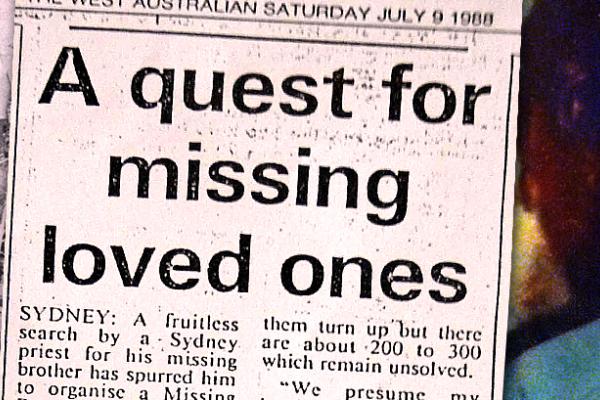 A family's legacyIn 1988, six years after 20-year-old Anthony (Tony) Jones went missing while hitchhiking around Australia, his family wanted to do something that would give hope to all families waiting for a loved one to come home. His brother, Brian Jones, after consulting heavily with other family members came to the determination that a week of action was required to commemorate those missing across Australia.As an initial act, a memorial service was held in Townsville where a tree was planted in commemoration of Tony by the Mayor of Townsville and with this the first ever National Missing Persons Week (NMPW) was born.The inaugural NMPW, which saw remembrance church services take place around the country, was just one of the initiatives Brian undertook to help find his brother and support others dealing with a missing love one.He wrote a book titled ‘Searching for Tony’, formed the NSW Family and Friends of Missing Persons Committee and, in 1988, founded the National Missing Persons Committee Inc. Countless ideas and opportunities were explored.In later years NMPW provided the basis for the creation of a hotline allowing those missing to call into police without giving their location. The ‘Phone Home’ initiative allowed a non-threatening way for people to contact relatives and friends.In part, he was driven by the fear that without ongoing publicity and community awareness, Tony’s case would quickly become a forgotten page in history.NMPW would be an annual event to help the Joneses and other families create publicity long after the initial interest in their loved one’s disappearance subsided. It would keep their hopes of a breakthrough alive.Brian’s vision was not misguided; a 1988 front-page story for the inaugural NMPW featured 20 of NSWs most puzzling missing persons cases. The story helped give answers to the families of 11 of those cases profiled.This year, in recognising the 30th anniversary of NMPW, Mark Jones – another of Tony’s brothers – spoke of his larrikin younger brother and the legacy he has created.“As the youngest of seven kids Tony was the chilled one, opting out of the often intense bids for attention that come with being one of many,” Mark said.“He didn’t sweat the small stuff, didn’t sweat the big stuff – in fact, he happily avoided anything that might cause sweat. He left the competitive sports and sibling rivalries to his crazy older brothers and sisters.“Growing up, Tony was hilarious to be around. He loved his beer, loved his mates and, more than anything, loved a laugh. Friends and family idolised Tony and his easy way of living. He liked shooting, sky diving and going bush.“Wanderlust set in when he was old enough to drive and he set off on several trips ‘east’ with mates. The last and most epic was a trip around Australia which began in Perth and was cut short when he vanished in Townsville, Queensland.”Since Tony’s disappearance, Mark has met numerous people from around Australia who came across their fun-loving brother during his road tripping adventures. An inquest discovered photographs and stories of his brother, such as when his old kombi van caught fire while driving through the foothills of Adelaide and melted his car keys into the ignition.“It’s interesting to look into the faces of strangers sharing memories of Tony,” Mark said.“There’s even a photo of a Tony that we never knew existed – the last one taken during his life. He’s standing around with a couple of fellas in Townsville, wearing a Coolabah Wine cask with eye holes cut out to make him look like Ned Kelly – it’s poignant and shows him for who he was: a true larrikin and adventurer. It is amazing and bitter sweet at the same time.”The fondness that everyone spoke of Tony and his wild nature was in line with what the Joneses knew so well – from getting locked in a disused fridge in the family shed to exploring a labyrinth of tunnels underneath the local police club.On the eve of the 30th anniversary of NMPW, Mark spoke of the complex and difficult aspects of having a loved one go missing.“How each person deals with the disappearance of a missing loved one is truly unique,” Mark said. “We are a large family of seven siblings and we have all dealt with the loss of Tony in different ways.“For me, every NMPW evokes a mix of emotions. The occasion is a source of great pride for my family and a silver lining after everything we’ve gone through with Tony. At the same time, it is heart wrenching to see a family at the early stages of having a loved one simply vanish. Their horror and despair is too real to us.“There is a mind-numbing ‘unreality’ about having a missing loved one that somehow pushes the grief to one side. But decades on it is all too easy to see the pain that lurks beneath the surface of bewildered people trying to make sense of a family or friend simply vanishing in a country seemingly as safe as Australia. Our family is beyond this now – we’ve been through so much. But every day there’s a family at the outset of this nightmare, whose lives are being thrown into turmoil. Sometimes our family has to look away, other times we wish we could be there to put an arm around those shattered people. In a way, that’s what we are doing each year with NMPW, and we want it to continue growing and helping more people.“After all, in missing persons cases, where there’s community awareness and publicity, there’s hope.”Anthony (Tony) was last seen in Townsville in November 1982. It is suspected by police that Tony was murdered while backpacking through North Queensland.5Aug 2018
 - 30th National Missing Persons Week
 30th National Missing Persons WeekThe Australian Federal Police (AFP) is providing Australians insight into the emotional pain faced by loved ones of missing persons, with a short film launched today marking the 30th anniversary of National Missing Persons Week (NMPW). The week will run from 5-11 August 2018.AFP Deputy Commissioner Neil Gaughan said he hoped the short film – which can be viewed on Facebook from 7am – will give the community a window into the profound heartache caused by this issue, as well as the critical role they can play in supporting police.“This film echoes the real life grief of so many Australians who live in constant uncertainty, not knowing if or when their loved one will come back,” DC Gaughan said.The concept of the short film was inspired by the real impacts and challenges faced when someone goes missing. In particular, many families across Australia are living with ambiguous loss, holding onto physical ties and the hope that their missing loved one will return.Eileen Fahey, whose son Anthony Fahey went missing in 2013, said the film’s narrative is similar to her own experience.“While we are currently endeavouring to sell our house, it’s upsetting because what if Anthony comes home and someone else is living here? How will he find us, how will he feel, what will he do?” Ms Fahey said.“I also worry that, if we sell, I won’t have the memories of him being in the house. I’m afraid that I’ll forget the image of him sitting at the end of the bench and the sound of his voice. It’s all tied up in the house – how can I leave it?”DC Gaughan said that, as part of the 30th NMPW activities, the AFP and its state and territory counterparts are also profiling 30 long-term missing people from around the nation on social media and outdoor advertising.“It’s important that we raise awareness of this issue, including the reasons why people go missing, the social and financial impacts, and how the community can get involved. This might mean taking an interest and sharing our social media posts, or sharing a photo of an outdoor advertisement. After all, the community is our eyes and ears in these cases, helping police find the many thousands of people who go missing each year.”“If you recognise any of the missing people profiled this NMPW, or indeed any of the 2600 long-term missing persons on the Public Register at www.missingpersons.gov.au, please contact Crime Stoppers on 1800 333 000,” DC Gaughan said. “You might just have a piece of information that could help bring them home.”The AFP’s NMPW 2018 activities are coordinated through the agency’s National Missing Persons Coordination Centre (NMPCC), with the short film created by Sydney-based creative firm Common Ventures.NMPW is supported by the Outdoor Media Association.For more information on the NMPCC and NMPW 2018, click here or see www.facebook.com/AFPNMPCC. The short film can be downloaded here.Media enquiries and interview requests:For more information or to request an interview, contact AFP National Media on 0437 477 430.Subscribe and receive email alerts(link: https://www.afp.gov.au/news-media/media-releases) when new media releases are published.4Aug 2018
 - International Missing Children’s Day 2018
 International Missing Children’s Day 2018On Friday 25 May we will honour International Missing Children’s Day. This is a time to remember children who are missing and support loved ones in their search.The day highlights the continued efforts of police, family, friends and the wider community to find missing children, and pays tribute to children who have been victims of crime. It is also a celebration of missing children who have found their way home.And this year is special. The Australian Federal Police (AFP) National Missing Persons Coordination Centre (NMPCC) is hosting the very first ‘Missing Youth Forum: educate, support, prevent’ to coincide with International Missing Children’s Day.The forum will see 30 year six students from local Canberra schools attend the Australian Institute of Sports (AIS) to collaborate and learn about the issue. They will leave as future ambassadors for the cause of missing youth.The forum agenda will address education around physical and cyber safety, emotional intelligence, mental health, access to support services. And will feature sessions facilitated by the Kids Helpline, Headspace, ThinkUKnow and Sasoon Simonian whose brother, Sevak, has been missing since 2014.The forum will empower the kids to go back to their respective primary schools, familiar with services they can utilise and options available to them. This is vital as they approach their teenage years, where unfortunately they become statistically higher risk of going missing.Recent research conducted by the Australian Institute of Criminology (AIC) indicates that:38,000 missing persons reports are made to Australian police each year. Three in five of those reports related to a young person under the age of 18, with 86% located within a week.Those likely to go missing, with a rate six times higher than the general population, are youth aged between the ages of 13 and 17.For further information on missing persons and to share the International Missing Children’s Day message with your networks, visit ‘The National Missing Persons Coordination’ Facebook page. Profiles can also be viewed at missingpersons.gov.au.The AFP works with state and territory police to profile missing persons, and the Family Law Courts to publicise and recover parentally abducted children.Anyone with information relating to a missing or parentally abducted child is urged to contact their local police or Crime Stoppers on 1800 333 00Media enquiries:AFP National Media: (02) 6131 6333Subscribe and receive email alerts(link: https://www.afp.gov.au/news-media/media-releases) when new media releases are published.24May 2018
 - New Missing Persons Research to Inform Future Law Enforcement Efforts
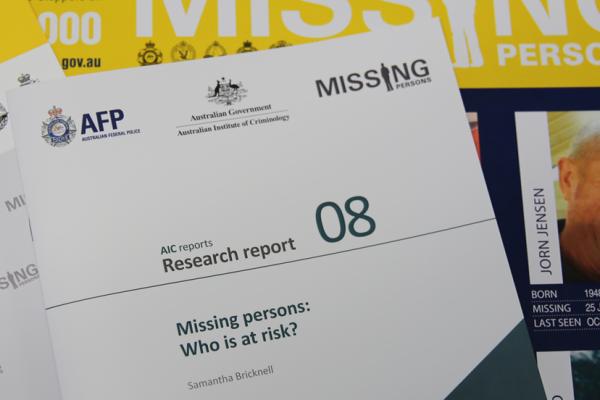 New Missing Persons Research to Inform Future Law Enforcement EffortsThis is a media release by the Hon Michael Keenan MP, Minister for Justice.Today I released the National Missing Persons Research Report: Missing Persons: Who's at Risk? which will inform our law enforcement agencies on the latest statistics on missing persons in Australia.This research is the first of its kind in over a decade – commissioned by the Australian Federal Police's National Missing Persons Coordination Centre and undertaken by the Australian Institute of Criminology.Between 2008 and 2015, over 305,000 missing persons reports were made to Australian state and territory police. In 2015, 40,580 missing person reports were received with almost half of these reports relating to young people aged 13 to 17 years – four times that of other age groups.Young Australians were also found more likely to be reported missing a number of times. Data from the Northern Territory showed 42 percent of people reported missing three or more times in a given year were young people aged 13-17 years.Data from Victoria shows elderly Australians, those suffering from a disability or mental health condition and individuals likely to cause self-harm or attempt suicide are at a higher risk of being reported missing. Five percent of reports related to people involved in domestic violence.The report also showed more men were reported missing than women, except those aged between 13 and 17. Missing persons with a mental illness and those who commit suicide were more likely to be male and middle-aged.These statistics are alarming. Our law enforcement agencies and their partners are doing excellent work to tackle the high number of missing Australians evident by most missing persons reports being resolved within 48 hours.But every member of our community can help. If you have information about the whereabouts of a missing person please contact Crime Stoppers on 1800 333 000.The full report can be viewed via our research page.15Nov 2017
 - Missing Person experts come together for conference
 Missing Person experts come together for conferenceAFP Commissioner Andrew Colvin opened the National Missing Persons Conference in Sydney today.For the first time, the AFP and NSW Department of Justice are co-hosting law enforcement, academics and professionals to share ideas, knowledge and best practice in the missing persons sector.Commissioner Colvin said that the two day conference will bring together some of the world’s leading experts on all aspects of missing people.“We are proud to have brought together policing, academic and non-government organisation leaders to share their knowledge at this inaugural event.“A wealth of information is on offer at the conference with six international speakers, key Australian researchers, investigators, forensic specialists and victim support services sharing their experience. This conference will greatly increase our collective knowledge on all aspects of missing persons.“In Australia, approximately 38,000 missing person reports are made to police each year; that is one person every 14 minutes; and more than 100 people every day. Approximately 85 per cent of people are located within a week and the vast majority are located, but in some instances this can take some time. However any time a person is missing it impacts their family and friends greatly,” Commissioner Colvin said.With a theme of Missing People: Challenges and Opportunities, topics will include updated missing persons research, new investigative techniques, the experience of grief and loss associated with missing people and their families, and improving responses to missing people and their families.NSW Commissioner of Victim Rights and head of the NSW Family and Friends of Missing Persons Unit, Mahashini Krishna, said “This is a landmark conference which has enormous potential to benefit how services and support are delivered to people who are dealing with the stress and trauma of a loved one disappearing”.Keynote speakers from the USA, United Kingdom and New Zealand will provide their expert knowledge about approaches to grief and loss, the missing persons sector and law enforcement practices.The conference is co-hosted by the National Missing Persons Coordination Centre (NMPCC) of the Australian Federal Police and the Families and Friends of Missing Persons Unit (FFMPU) of the NSW Department of Justice.14Nov 2017
 - Missing Persons Conference - November 2017
 Missing Persons Conference - November 2017The inaugural National Missing Persons Conference will be held in Sydney, Australia, on the 15 and 16 November 2017.The conference will bring together law enforcement, academics, and professionals in the government, non-government and community sectors to stimulate discussion, and encourage collaboration and best practice in the missing persons sector.The theme of this year’s conference is Missing People: Challenges and Opportunities, centring around updated research across the missing persons’ sector, new investigative techniques, the experience of grief and loss associated with missing people and their families, and improving responses to missing people and their families.The conference will feature presentations from researchers, police, social workers, psychologists, and policymakers. International keynote speakers will present on their renowned work in the areas of grief and loss, evidence-based policing, and the future of missing persons’ investigations.The conference agenda and abstracts are now available, and can be downloaded and viewed via the two links below.Keynote SpeakersWorld renowned keynote speakers specialising in approaches to grief and loss, the missing persons sector, and law enforcement practices have been secured for the Missing People: Challenges and Opportunities national conference.Dr Kenneth J DokaGraduate School of The College of New RochelleProfessor of GerontologyHospice Foundation of AmericaSenior ConsultantDr Darcy L HarrisKing's University CollegeAssociate Professor Thanatology CoordinatorDr Lois TonkinUniversity of Canterbury/Te Whare Wananga o WaitahaLecturer in Counselling and Specialist EducationQuoc VoThames Valley Police, UKDetective SergeantDixie PetersUniversity of North Texas Health Science CenterCenter for Human IdentificationTechnical Leader - Missing Persons UnitGeoff NewissAction Against Abduction, UKChief ExecutiveKingston University (London)Visiting Research Fellow26Oct 2017
 - Day for Daniel - 'Tour de Tassie'
 Day for Daniel - 'Tour de Tassie'In partnership with the Daniel Morcombe Foundation, the Commonwealth Bank of Australia and Tasmania Police, the AFP is proud to again support Day for Daniel (Morcombe) through an educational tour of Tasmania, 'Tour de Tassie'.Building on the success of last year’s ‘Tweed to the Territory’ tour, and the AFP’s role in reducing the incidence and impact of Commonwealth crimes against the person, the National Missing Persons Coordination Centre and 'ThinkUKnow' Cyber & Child Safety team will extend the reach of our child protection messaging by jointly facilitating a two-week (4-15 September) tour of Tasmania.The two-week tour will incorporate the Daniel Morcombe Foundation’s ‘Recognise, React, and Report’ child safety program, in addition to the AFP’s ThinkUKnow cyber safety education program which will be delivered to parents, carers, and teachers in Hobart, Launceston, Devonport, and regional surrounds.Focusing on the importance of personal and online safety, the tour will take place during National Child Protection Week (3-9 September), and will mark the 12th year of the AFP's support of the Daniel Morcombe Foundation.14Sep 2017
 - Child Safety the focus of Tasmania roadshow
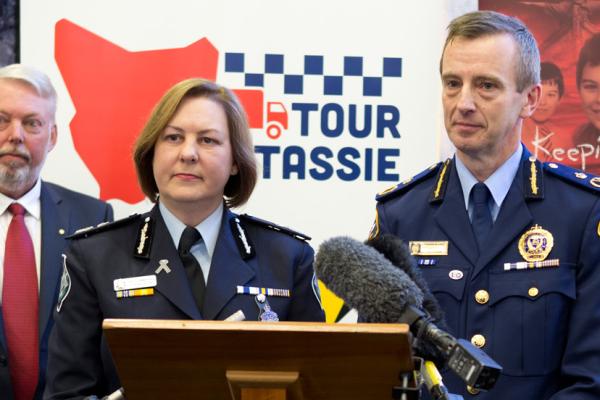 Child Safety the focus of Tasmania roadshowThe Australian Federal Police (AFP) – together with the Commonwealth Bank of Australia, the Daniel Morcombe Foundation and Tasmania Police – is today launching an educational tour to increase awareness of child safety and missing persons ahead of Day for Daniel in October.The Tour de Tassie roadshow will visit more than 20 schools and reach thousands of schoolchildren, their parents, carers and teachers over the next two weeks. It aims to educate students about being safe in their communities and encourages adults to have open conversations with children about personal safety.As well as school presentations, there will be three ‘ThinkUKnow’ super sessions held in Hobart, Devonport and Launceston. ‘ThinkUKnow’ is a free, evidence-based program that provides cyber safety education in Australia delivered in partnership with the Commonwealth Bank of Australia, Datacom and Microsoft. Presentations cover online grooming, sexting, privacy, inappropriate online behaviours, identity theft and fraud and general online safety.The super sessions aim to educate parents, carers and teachers on what young people see, say and do online, and how to overcome challenges. AFP Deputy Commissioner Operations Leanne Close said crime prevention was key. The tour harnesses the unique partnerships between law enforcement, industry and non-government organisations.“Everyone has a role to play in improving child safety and preventing harm in their communities and this is particularly important in the lead up to National Child Protection Week on Sunday,” Deputy Commissioner Close said.“We are urging parents, carers and teachers to register to go along to the ‘ThinkUKnow’ super sessions to get up-to-date on their children and teenager’s online activity.”Commonwealth Bank State Manager for Tasmania Marco Artini said, “With a large branch network across Tasmania, and over 30 Commonwealth Bank employees from the region trained by the AFP to deliver ThinkUKnow online safety sessions, we are proud to be supporting parents and families in our local community.”Bruce Morcombe said The Daniel Morcombe Foundation has been working with the AFP for over a decade.“In recent years we have shared tours to various mainland regions around Australia promoting child safety,” said Mr Morcombe.“We are really excited about the Tour de Tassie, as on a personal level, Tasmania is my home away from home. Denise and I have owned property here since 2006.”Tasmania Police Commissioner Darren Hine said, “Technology has never before been as accessible to our children as it is today and I encourage everyone in our community to play their part in keeping children safe from online harm.”"Technology can be a wonderful thing but with all its benefits there can be a darker unsafe side for children and it is our job as parents, carers, and law enforcers to make sure they are properly prepared for taking part in the online world.”"Tasmania Police wholeheartedly supports the ‘Tour de Tassie’ educational initiative and welcome our partner agencies to Tasmania for the official launch today," said Commissioner Hine.Day for Daniel is the largest child safety awareness day of its type in Australia. More than 2000 schools have already registered to take part in the national day of action. For information on events and the Daniel Morcombe Foundation, visitdanielmorcombe.com.au.For information on the ThinkUKnow cyber safety program, visit www.thinkuknow.org.au.For information about missing persons in Australia, visit www.missingpersons.gov.au. Media enquiriesAFP National Media: (02) 6131 6333.CommBank Media: (02) 9118 6919Daniel Morcombe Foundation: 0420 300 737Tasmania Police Media: (03) 6173 24241Sep 2017
 - Young people a focus for National Missing Persons Week
 Young people a focus for National Missing Persons WeekThis is a joint media release issued by the Australian Federal Police and Queensland Police.The Australian Federal Police and the Queensland Police Service today launch National Missing Persons Week for 2017, with a specific focus on the 25,000 young people reported missing to police each year across Australia.More than 38,000 people are reported missing each year, with two thirds under the age of 18. While the majority of missing persons are found within a short period of time, there remain more than 2000 people who are listed as long-term missing persons; people who have been missing for more than three months.AFP Commissioner Andrew Colvin said for every missing person there are family, friends and colleagues left behind, still waiting for them to come home.“We could fill the GABBA today with the number of people reported missing to police in Australia every year,” Commissioner Colvin said.“ … And for every missing person, there are families and friends left behind not knowing what has happened to someone they care deeply about.”Young people may go missing for a range of reasons, including miscommunication, misadventure, or because of a misunderstanding. In some circumstances going missing may be seen as the only option to leave a bad situation, and in the most extreme of cases, a young person may have become a victim of crime.Those aged between 13 and 17 are six times more likely to go missing than the rest of the Australian population.Queensland Police Service Acting Deputy Commissioner (Specialist Operations) Tracy Linford said this year the focus through the campaign “Still waiting for you to come home” would be on the high number of youth that were reported missing each year.“Today is the appropriate day to announce the QPS Snapchat capability where the demographics in Australia are largely in the 18 to 25-year-old age group so it enables us to send information and images to these people,” Acting Deputy Commissioner Linford said.“It additionally broadens the current social media reach the Queensland Police Service has to further share information about missing people.“On average, around 100 people are reported missing to police every week in Queensland. We as a police service do all we can to help families find their loved ones, so this is a logical extension to our already large reach in the social media sphere.”There is no need to wait 24 hours to report someone missing. A report can be made as soon as there are fears for the person’s welfare and safety, and their whereabouts are unknown.Going missing is not a crime. People reported missing and subsequently located by the police will not be charged. If you are a missing person, today might be the day where you let your family and friends know you are OK.National Missing Persons Week is supported by Outdoor Media Association, Chemist Warehouse and McDonald’s Australia.To view Australia’s national register of missing persons, visit the National Missing Persons Coordination Centre website at www.missingpersons.gov.au, where information about support services across Australia can also be found.Anyone with information relating to a missing person is urged to contact their local police or Crime Stoppers on 1800 333 000.Media enquiries:AFP National Media: (02) 6131 6333Queensland Police Media: (07) 3015 244431Jul 2017
Do you have any information relating to a missing person?
Report to Crime Stoppers on
or
Report information via their website
Do you need an interpreter?
If you require assistance in contacting the NMPCC, we are a client of the national Translating and Interpreting Service (TIS National).
Call TIS National on
Call 24 hours, seven days a week.
This service is available to anyone in need of an interpreter. Information translated by TIS National Service is kept strictly confidential.
Do you want to report someone missing?
Call Police Assistance on
Or visit your local police station
Media and partnership enquiries
For all media enquiries please contact AFP Media
Call AFP Media on
or
Email AFP Media at