
Searching for Susan
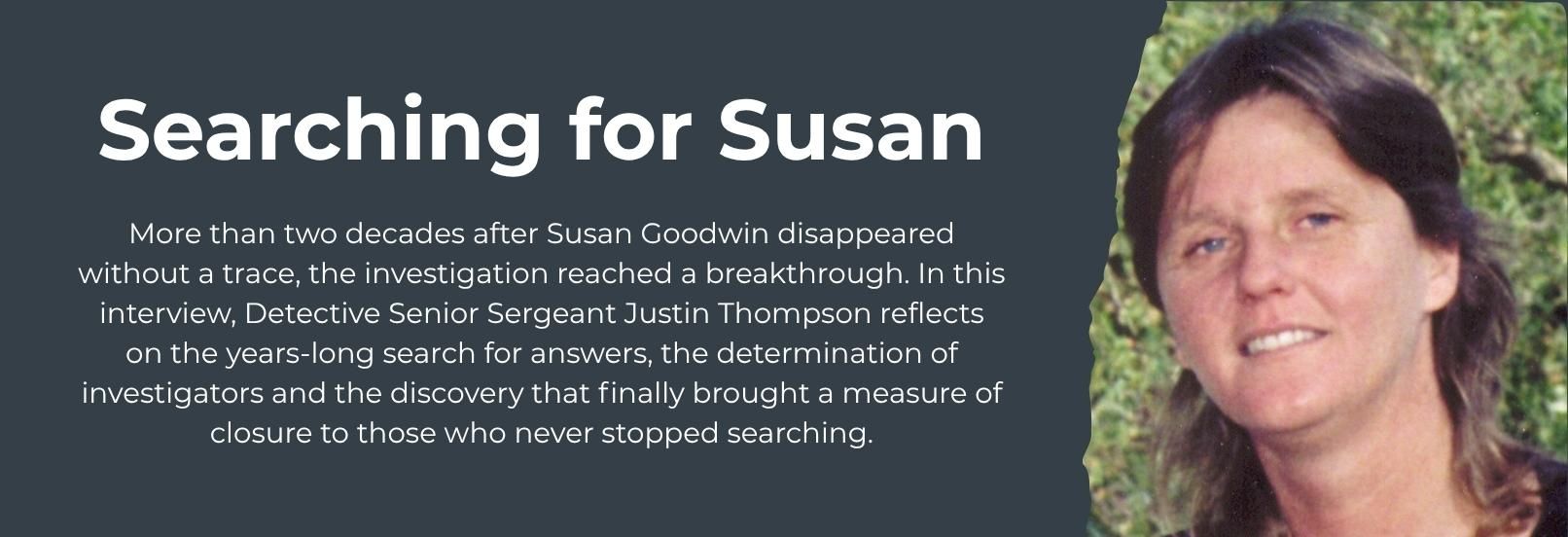
More than two decades after Susan Goodwin vanished from Port Lincoln without a trace, a new interview, Searching for Susan, provides insight into one of South Australia's most enduring long-term missing person investigations and the painstaking work that ultimately led police to her remains.
In the interview, Detective Senior Seargent Justin Thompson touches on the life of Susan Goodwin, the circumstances surrounding her disappearance in July 2002, and the determination that drove investigators through years of unanswered questions, public appeals and extensive reviews.
Born and raised in country Victoria, Susan Goodwin was one of five children. Her life changed dramatically in 1984 when a serious car crash claimed the lives of three of her siblings and left her with significant injuries that would affect her for the rest of her life. Despite ongoing physical and mental health challenges, Susan Goodwin built a life with her partner Michelle and eventually settled in Port Lincoln, a community that would become central to the investigation following her disappearance.
The interview carefully retraces Susan’s final known movements on 19 July 2002. After dropping Michelle at work as part of her normal daily routine, Susan Goodwin spent the morning running errands around town before visiting a property at 5 Pamir Street, one of the last locations where she was known to have been seen.
Investigators say the last confirmed communication from Susan occurred at 2.38pm that afternoon. Later that day, when she failed to collect Michelle from work as planned, alarm bells began to ring. Their shared vehicle was later found at home, unlocked and without its keys, but there was no sign of Susan.
Justin explains that, in the early stages, detectives were faced with a range of possibilities.
"Many people get reported missing each day. The great majority of them are found very early on. People go missing for a number of reasons, so we had to explore all those options and not discount anything."
Among the theories investigated were whether Susan Goodwin had voluntarily left Port Lincoln, suffered a mental health crisis, experienced a fatal overdose, or become the victim of foul play.
As the investigation progressed and evidence was assessed, police became increasingly convinced that Susan Goodwin had not simply disappeared of her own accord. In 2013, a reward of up to $200,000 was offered for information relating to her suspected murder or the location of her remains.
In addition to the reward offered for information relating to Susan an extensive case review was launched in 2017, which investigators describe as a turning point in the long-running investigation.
Police undertook an intensive community engagement campaign, distributing posters throughout Port Lincoln, placing Susan Goodwin's image on thousands of beer coasters, displaying her photograph on police vehicles and sending letters to prisoners with knowledge of the local area in the hope of uncovering new information.
According to Justin, much of the progress came from old-fashioned detective work.
"It was really just feet on ground, out speaking to people."
Years of interviews, tip-offs and community information allowed investigators to work through rumours and eliminate alternative lines of inquiry, gradually narrowing their focus.
The interview also explores the significance of 5 Pamir Street, Port Lincoln, a property that remained firmly on investigators' radar for many years. While the location had long been considered important, practical challenges, including structures built over the site and significant amounts of debris in the yard, made a comprehensive search difficult.
Justin reveals that the property remained a key focus throughout the review process.
"I was never happy in finalising our review until that property at 5 Pamir Street had been searched."
The breakthrough finally came when the property became vacant and was cleared, giving investigators what Justin described as the ideal opportunity to conduct a thorough examination of the site.
Working alongside the Australian Federal Police, South Australian Police (SAPOL) utilised ground-penetrating radar technology to identify potential areas of interest beneath the surface. During excavation works, investigators discovered what appeared to be a human femur protruding through the soil.
"It was sort of a surreal moment."
The discovery led to the careful recovery and identification of Susan Goodwin's remains, marking a significant development in a case that had remained unresolved for more than 22 years.
Throughout Searching for Susan, Justin repeatedly highlights the importance of community support and collaboration between agencies in achieving that outcome.
"Every bit of information is important."
He credits the local community, Crime Stoppers reports, specialist support from the Australian Federal Police and Forensics Specialists, alongside years of persistent investigative work as critical elements in the search for answers.
While Susan’s case currently remains before the courts and investigators are limited in what they can publicly disclose, the interview offers a powerful reflection on the persistence required in long-term investigations and the profound impact unresolved cases have on loved ones.
One of the most moving moments comes as Justin recalls informing Michelle that Susan had finally been found.
"The day when we found her and had to go over and actually tell Michelle would be something that will never leave me."
Ultimately, Searching for Susan is not only a story about a police investigation. It is a story about perseverance, community involvement and the enduring hope of finding answers, no matter how much time has passed.
As Justin concludes:
"No matter how old the case is, if you have information, speak to police. These inquiries are always open. We're always seeking new information."
You can listen to the full interview and read the complete transcript below.
Interview Transcript:
Interviewer
Behind every missing person case are loved ones waiting for answers.
When Susan Goodwin disappeared from Port Lincoln in July 2002, her loved ones were left with a question that would remain unanswered for more than two decades: What happened to Susan?
Today, we're speaking with Detective Senior Sergeant Justin Thompson from South Australia Police, who worked closely on the case for many years. Together, we'll explore Susan's life, the investigation into her disappearance, the role of the local community, and the discovery that finally brought some measure of closure.
This is Searching for Susan.
Interviewer
So, Justin, for listeners unfamiliar with this case, can you give us a brief overview of who Susan Goodwin was and why this investigation has remained so significant over more than two decades?
Interviewee
Susan, she was born and raised in country Victoria. She was one of five children to her parents, Margaret and Don Goodwin. Her childhood and early adult years were, you know, largely unremarkable. However, it's in 1984, when she was 24 years old, she was involved in a serious car accident, which claimed the lives of three of her siblings.
And as a result of that car accident, she suffered some fairly significant ongoing neck and back injuries. And really was from that time on was sort of unable to work, and was placed on a support pension, which basically remained her primary source of income throughout her years. In 1989, she developed a relationship with a, a resident in another resident in country Victoria, a lady by the name of Michelle. They were both from a little town called Wonthaggi in Victoria. And in the early years through the early 90s, Susan and Michelle, travelled around Australia and had a holiday, and they, at the time, they visited a town in South Australia called Port Lincoln, which is another country town on the Eyre Peninsula.
And, they, sort of fell in love with the town. They both returned to sort of Wonthaggi, but then, around 1991 they separated for a short time, and, Michelle left Wonthaggi and she moved and started living in Port Lincoln. About three years later, Susan and Michelle sort of rekindled their relationship. And Susan moved over to Port Lincoln, where they were, both living together.
Susan was a sociable person. She mixed well with others, but she had a fairly small, close circle of friends. And she did suffer from some, mental health problems, some anxiety and, you know, she was very reliant on her partner, Michelle. And they had a good relationship together.
And got on well together and as I said, just continued to live in the town of Port Lincoln. Investigations remain so, so significant. I guess it's like any investigation none is any more significant than the other. The fact of, she'd been missing for so long in itself, is significant not only to the police, but obviously even more significant as well to the family members and the people that are left behind.
Port Lincoln's very small, again, small country town in South Australia and incidents like these don't occur very often. So, for a town like Port Lincoln and the community there, it, has remained a significant matter over a long time.
Interviewer
What do we know about the circumstances of Susan's disappearance, and how did police initially respond at the time?
Interviewee
The day that Susan disappeared on the 19th of July 2002. It was a Friday, around 6:40 a.m. in the morning Susan did her usual thing, and that was to drive her partner Michelle to, work in Port Lincoln and dropped her off. Again, this is part of her daily routine.
We know Susan then returned back to her home address in Port Lincoln. We know, at about 10:13 a.m. that morning, she, telephoned a local service station and discussed, having a gas delivery to her residence. And then there was a number of people after that that also sighted Susan, throughout the town, driving around, she was running a few errands, doing some grocery shopping.
And we also, recovered some supermarket dockets from her home address that showed that she would have been shopping the local supermarket during the morning and, in towards midday that day. Michelle's brother also lived in Port Lincoln, and he lived in a, address in, Pamir Street in Port Lincoln.
And we know Susan went to visit, Michelle's brother at that location. And that was at about, round about 12:45. We've got confirmation of her going there. Whilst still parked at Michelle's brother's house at 6 Pamir Street. She went across the road to another residence at 5 Pamir Street, in Port Lincoln to speak to the occupant there.
Now due to the ongoing investigation, I can't make too much more comment about her reason for attending there. But we know that she spent a short time there at the address at 5 Pamir Street, and we know that she did leave that house, got back in her car and drove and returned to her home address.
We know then at 2:38 p.m. on the 19th of July, we know that Susan made a phone call from her home phone to a person that's known to us. But again, I can't really go into the circumstances about, that phone call. But what I can say that was the last known, communication that anyone had had with Susan after that time, and there have been no further sightings of her.
And so around 4:15 in the afternoon, again, the daily routine would be that Susan would go and pick up her partner Michelle from work when she’d finished, on this occasion, at around 4:15, she's meant to be picked up, she didn't arrive and Michelle had to find her own way home. When she got home, the car that they jointly owned, their only car, was parked in the drive.
Had no keys with the car, it was unlocked, had no keys, and, Susan's wallet was also not located at home. But there was no sign of Susan. And from that point, she had never been seen. And Michelle obviously started making inquiries to try and find her. And, subsequently ended up contacting police.
Interviewer
What theories or possibilities were being considered early on, and what made it so difficult to determine what had happened to Susan?
Interviewee
Yeah. Look with these cases, they are difficult because, initially there is a number of theories that are thrown up, for various reasons. We had the theories that maybe the relationship between, Susan and Michelle wasn't that good and, that, Susan simply just has left and taken off, and just hasn't told anyone about it but she wanted to escape Port Lincoln for some reason. That was certainly, one of the theories that crossed the mind of police. There was there were some early on rumours floating around like, Susan was a, did use illicit drugs. I wouldn't say a heavy user or anything like that, by no means, but she was a, casual user of illicit drugs.
So there was theories floating around that maybe that she had visited a friend and had a drug overdose. And, that reason that was trying to be hidden and, they’ve disposed of her or something like that. That was a possibility that was thrown out. As I mentioned before, she did have some, some ongoing mental health issues so that was thrown up that maybe they got too much for her and she again similarly wandered off to go and get some, find some time and get some space. And also obviously looking at the possibility of was foul play involved. So, you know, a number of possibilities get, explored early on and it is a difficult situation, as we know. Many people get reported missing each day. Great majority of them are found very early on. And people go missing for a number of reasons. So we had to explore all those options and not discount anything but early on obviously we just had no real idea that she just vanished with no trace.
Interviewer
Over the 22 years, what were some of the key investigative efforts, such as public appeals, the reward and the 2017 task force review, and how did they contribute to progressing the case?
Interviewee
Early on, there was a number of public appeals through the media. In 2013, so it was sometime after, Susan had gone missing, a reward was applied for and granted that was up, reward for up to $200,000 for information on Susan's murder, and or the location of her remains.
By the time we got to that far down the track, we were much more confident that we were investigating foul play and that, she, in fact, hadn't just wandered off. So therefore, a reward was granted. In 2017, I managed a review into her case. When we re-looked into it again and then we did a lot of unprecedented sort of strategies, appealing for public information. So we printed a number of posters, which we placed across all sort of local businesses throughout Port Lincoln, and we printed off thousands of, beer coasters, which we rolled off into licensed premises in Port Lincoln. It was just basically with her photograph on it and basically any information that anyone would have, in regards to her disappearance, to contact police. We placed, like, wraps around the rear of police vehicles the rear windscreen of police vehicles with big pictures of, Susan on it.
So they were visibly getting seen throughout the community, again conducted a number of media appeals, and we also sent letters to all prisoners that were within the Port Lincoln prison, to see if they had, if anyone within the prison in the criminal society had any, information in regards to that, to contact police. With the small town, small town like Port Lincoln made it more of a concentrated area where, made it, I guess, easier for us to have this sort of campaign and, run it through local businesses and the prison and things like that.
So we did receive a lot of positive response and a number of phone calls to Crime Stoppers, which did result in some fresh information, that we continued to investigate.
Interviewer
How did investigators ultimately eliminate other leads and narrow the case down to a single suspect?
Interviewee
Basically a lot of hard work and just old-fashioned sort of detective work. And it was really just feet on ground out speaking to people. Back in 2002 and especially in, again, a town like Port Lincoln, things like CCTV, was limited, mobile phone use was limited so it was really just speaking to people and, especially in 2017 when we reviewed the case, we spent many weeks over in Port Lincoln, speaking with locals, again, a country town. Throughout the years, a lot of rumours had circulated throughout the town, and a lot of people, other people had been nominated as possibly being involved or having information.
So we spent a big chunk of time speaking to people and sort of negating any rumour, to try and work out exactly what sort of evidence and information we had. Took a long time to eliminate, those rumours and get to the bottom of them, which we continued on for several or many years, until we ultimately come up with, where we found her.
Interviewer
What changed that allowed investigators to search 5 Pamir street in Port Lincoln? And why was that moment so critical?
Interviewee
Yeah. Look, there was no real moment as such. There was a change. And again, I need to be a bit careful on what I say, but there was a number of people we were investigating as part of the review, and a number of, locations we were looking at, and during the investigation, as I said before, a number of people were spoken to, and there was a number of searches conducted for Susan.
I guess I personally was, was never happy in finalising sort of our review that had commenced in 2017. Until that property at 5 Pamir Street had been, searched. It was one of the, last, places that she was seen to attend at. And for me, I just, you know, there was evidence that led us to that location, obviously, but also it was a it was a gut feeling that just something wasn't right about that location, and look there was a number of reasons that, that house had remained, significant. But also there was a number of reasons why it couldn't have been searched earlier. The rear yard in particular had a number of structures over the years that had been built. And there was also the whole property, rear yard was totally full of rubbish and items and cars and things like that.
And sort of logistics of doing the search that property as thoroughly as I wanted to was very difficult with all this building that had gone on afterwards and structures. And like I said there's a lot of other factors that I can't go into that at this time on why we didn't, but that was sort of it was always had been on our mind there for some time that we wanted to search that property. We just had to wait for the right time.
Interviewer
Can you walk us through how Susan was located and what role technology like ground penetrating radar played in that process?
Interviewee
By September 2025, things had changed at 5 Pamir Street. It was now vacant, structures that had been erected in the rear yard, previously had all been, taken down by the, Housing SA. And all the rubbish had been removed from the yard and basically been, the property had been returned to its original bare state. So presented us with the perfect opportunity that we had sort of a blank canvas of the rear yard that we could conduct a thorough search of.
So we liaised with the AFP, and their assistance in regards to the ground penetrating radar, which they have, the equipment and the expertise to use, to survey the rear yard of that property. That was conducted over a two day period and, a number of areas of interest were located, which we then sought to excavate. An excavator was brought in and it was only on our second, second area that we'd identified that we were digging whilst the excavator was carefully, pulling back the soil it sort of hit a sort of a bit of a rocky patch.
We had consideration on if we would think. Okay, well, we would stop there or we'd go again and we as a team, decided, we'll just go one more, one more, scrape with it over just to remove some of the rocks. Which they did. And then a, a bone protruded through the soil.
We had a look at the bone was sort of a surreal moment, I guess. But, we looked at the bone and it looked, to us as a human femur bone. So we immediately stopped excavation. I sought some advice from the, forensic anthropologist back in Adelaide over the phone, exchanged some photographs of what we'd found, they, agreed that it appeared human remains. And then we shut down the scene and waited for arrival from forensic specialists from Adelaide to come back. And then we, commenced the very careful, exhumation of the remains of Susan.
Interviewer
How important was collaboration between SAPOL, the Australian Federal Police, and information from the public in reaching this outcome?
Interviewee
Oh, look, it's highly important. And look it might be a bit cliche, but every bit of information is important. Even if the information is in the end is proven to be incorrect. But we had massive input from the local community. As I said again, a lot of the information we had from the community ended up being rumours and did end up being incorrect, but it still, as a whole helped us paint a picture of what was going on.
It would be encouraged that people would call us regardless and let us I guess, decide on, the validity of the information because I guess we as investigating would know a lot more behind the scenes of what's going on than, say, a member of the public would. But the collaboration with the AFP proved pivotal as well.
They had the expertise and the equipment that we needed. And at the end of the day, we will liaise with whoever we need to, through law enforcement or through the private sector or whatever equipment we may need or expertise we may need when it comes to, finding people like this.
Interviewer
Where does the case currently stand in the legal process, and are there any further developments at this point in time?
Interviewee
Yeah, again, I cannot I cannot say too much, other than it's before the courts. And could be a lengthy, lengthy process before we finalise the matter, it's only in its early stages in the court system.
Interviewer
Looking back, what does this case say about persistence in long term investigations? And what message would you like to share with the community?
Interviewee
Yeah, I think it shows as investigators, that we will never give up. For various reasons, investigation can slow and all avenues of investigations might be explored, but then, all of a sudden, new information comes in or reviews are conducted with a fresh set of eyes, and then we're off again exploring new avenues and new lines of inquiry start to open up.
I guess the message is that, no matter how old the case is or if you think a case is done and dusted but regardless if you have the information, then speak to the police no matter what you think may have happened with this case. Because I can say these inquiries and these cases are always open. We're always seeking new information. Where you know, that little bit of information could be what we need to spark off into a new entire investigation and, you know, hopefully we can bring in some sort of conclusion.
I’m sort of well aware now, you know, I had this case for 12 or 13 years, and worked very closely with the family, worked very closely with Suzanne's partner, Michelle.
And I saw firsthand over many years, what this means to the family and what it means to them. And, you know, the day when we found her and had to go over and actually tell Michelle, will be something that sort of will never leave me, just to see her face after all this time, you know, it stays with them forever.
And she's lived her whole life with this in mind every day. So, it just says how much it means to families to get some sort of conclusion.
Interviewer:
The story of Susan Goodwin is a reminder that missing persons investigations aren't measured in days or months, but in the lasting impact they have on families, friends and communities.
As we've heard today, investigative persistence, community support and a commitment to following every lead helped bring answers after more than 22 years.
Our thanks to Justin and South Australia Police for sharing insights, and to everyone who contributed information throughout the course of the investigation.
If you have information about a missing person, please contact Crime Stoppers online, or call 1800 333 000.
This has been Searching for Susan. Thank you for listening.